
We are thrilled to welcome you into the world of advanced lighting technology. Mastering light intensity is essential for creating the perfect atmosphere in any space, and we are here to make that process simple et efficace.
By exploring PWM dimming, you gain precise control over your environment. This method stands out as a highly reliable way to manage brightness without sacrificing energy efficiency or performance.
Our team at IMLT LED is dedicated to helping you achieve your vision through innovative solutions. Whether you are a homeowner or a business owner, we simplify complex technical concepts to ensure your projects shine bright.
You can discover more by visiting our website at www.imltled.com. If you have specific questions, feel free to reach out via WhatsApp at 0086 185 8848 3178 or send an email to [email protected]. We look forward to helping you Illumine ton monde sans difficulté.
Principaux enseignements
- Pulse Width Modulation offers superior control for modern LED systems.
- Achieving the perfect ambiance is now simpler than ever with our expert guidance.
- We prioritize innovative and reliable solutions for all your lighting needs.
- Direct support is available via WhatsApp and email for your convenience.
- Our mission is to make smart lighting technology accessible and enjoyable for everyone.
Understanding PWM Dimming
When we look at modern lighting, the secret to precision often lies in a clever technique called PWM dimming. By exploring PWM dimming, we can better appreciate how our living spaces transform with just a simple adjustment. This method provides the control needed to create the perfect atmosphere for any occasion.
What is PWM Dimming?
Pulse Width Modulation, or PWM, is a highly effective method for regulating LED brightness. Instead of lowering the voltage, it adjusts the width of the electrical pulses sent to the light source. This ensures that the LED maintains its optimal color temperature even when dimmed to very low levels.
How Does PWM Work?
The system functions by rapidly switching the electrical current on and off at a high frequency. Because this happens so quickly, the human eye perceives a steady, dimmed light rather than a flickering one. By changing the ratio of “on” time to “off” time, we control the average power delivered to the diodes.
This rapid cycling is essential for achieving the best lighting for home environments where consistency is key. It allows for smooth transitions that feel natural and comfortable. We find that this approach prevents the color shifting often seen in older, analog dimming systems.
Advantages of PWM Dimming
There are several reasons why this technology has become the industry standard for smart lighting. It offers unmatched precision and helps maintain the longevity of your LED components. Below is a breakdown of why this method stands out:
| Fonctionnalité | PWM Dimming | Analog Dimming |
|---|---|---|
| Color Stability | Excellent | Poor |
| Plage de gradation | Wide (0-100%) | Limitée |
| Efficacité | Haut | Modéré |
| Flicker Risk | Low (High Frequency) | Haut |
- Efficacité énergétique : Minimizes power waste during operation.
- Color Consistency: Prevents unwanted shifts in light hue.
- Precise Control: Allows for granular adjustments to brightness levels.
The Science Behind Pulse Width Modulation
At the core of modern lighting innovation, Pulse Width Modulation serves as the primary engine for precision. We rely on this method to transform raw electrical power into the beautiful, adjustable light that defines your living space.
Technical Explanation of PWM
PWM functions by rapidly switching an LED on and off at a very high speed. Because this happens so quickly, your eyes perceive a steady, continuous glow rather than a series of flashes. This rapid cycling is the secret to achieving perfect brightness levels without sacrificing the efficiency of the diode.
Frequency and Duty Cycle
The relationship between frequency and duty cycle is what gives you granular control over your environment. The frequency represents how many times the light switches per second, while the duty cycle determines the ratio of “on” time versus “off” time.
- Frequency: Must stay above 100Hz to ensure the human eye cannot detect any flickering.
- Duty Cycle: A higher percentage results in a brighter light, while a lower percentage dims the output.
“True innovation in lighting is not just about the bulb, but about the invisible precision of the control system that powers it.”
Impact on LED Performance
When you choose between Warm Light vs. Cool Light, the underlying PWM technology ensures that your color temperature remains stable regardless of the dimming level. This technical consistency is vital when you are exploring various interior lighting options for your home or office.
By maintaining a high switching frequency, we ensure that your light output remains smooth and comfortable. This scientific approach allows you to enjoy a flicker-free experience that enhances the mood of any room while keeping your energy consumption low.
PWM Dimming vs. Other Dimming Methods
We often find that the method used to dim your lights significantly impacts the overall performance and color consistency of your LEDs. Selecting an effective dimming strategy requires a clear understanding of how different systems interact with your light fixtures. By choosing the right technology, you ensure that your space remains perfectly lit for any occasion.
Comparing PWM to Analog Dimming
Analog dimming works by reducing the current sent to the LED. While this seems simple, it often leads to color shifts at lower intensities. This is particularly noticeable when you are trying to balance Warm Light vs. Cool Light in a professional setting.
PWM dimming, however, maintains the white point of the LED output by rapidly switching the power on and off. This superior stability ensures that your color temperature remains constant. Whether you prefer a crisp look or a cozy glow, PWM keeps your lighting design professional and visually appealing.
Benefits over Phase-Cut Dimming
Phase-cut dimming is a traditional method often used with incandescent bulbs, but it frequently struggles with modern LED drivers. You might experience annoying flickering or buzzing noises when using these older systems. PWM avoids these issues entirely by providing a clean, digital signal that LEDs understand perfectly.
When you compare cool vs warm white light performance, PWM offers a much smoother transition. It eliminates the “dead zones” where lights might suddenly turn off or jump in brightness. This precision makes PWM the choix préféré for high-end smart home installations.
Applications for Each Dimming Type
Different environments require specific dimming solutions to achieve the best results. The following table outlines where each method typically excels in modern lighting design.
| Dimming Method | Meilleur cas d'utilisation | Key Advantage |
|---|---|---|
| PWM | Smart Homes & Retail | Perfect Color Stability |
| Analog | Simple Industrial | Low Complexity |
| Phase-Cut | Legacy Retrofits | Existing Wiring |
Common Applications of PWM Dimming

We believe that mastering light control starts with understanding the versatility of PWM systems. This technology acts as the backbone for modern electrical management, allowing for precise adjustments in everything from simple household bulbs to complex machinery. By rapidly switching power on and off, we can achieve levels of control that were previously impossible.
Solutions d'éclairage résidentiel
Creating the perfect atmosphere in your living space is easier than ever with advanced dimming technology. We know that the right lighting temperature can completely transform a room, shifting it from a vibrant workspace to a relaxing sanctuary in seconds. Finding the best lighting for home comfort is a priority for many, and our lumières télécommandées provide the seamless experience you deserve.
Commercial Lighting Uses
In commercial environments, efficiency and ambiance must work hand in hand. Businesses rely on PWM to maintain consistent illumination while significantly reducing energy waste during off-peak hours. By fine-tuning the lighting temperature, managers can create inviting retail displays or productive office environments that keep employees and customers happy.
Industrial Automation and Control
Beyond simple illumination, PWM plays a critical role in industrial automation and motor control. It allows for the precise regulation of electrical equipment, ensuring that motors run at the exact speed required for specific tasks. Reliability and precision are the hallmarks of these systems, helping industries maintain high standards of operation while keeping energy costs under control.
How to Implement PWM Dimming in LED Systems
We believe that mastering the implementation of PWM dimming is the key to unlocking professional-grade lighting control. By selecting the right hardware, you can create a system that is both highly efficient and incredibly reliable. Our goal is to make this technical process feel simple and rewarding for your next project.
Required Components for PWM Control
To build a robust system, you need to start with a few essential building blocks. A logic level FET transistor is the most critical component, as it acts as a high-speed switch to manage current flow effectively. You will also need a reliable PWM controller capable of generating a stable signal to drive your LEDs without any unwanted flickering.
Beyond these, ensure you have a stable power supply that matches the voltage requirements of your LED strips. Using high-quality wiring and connectors will prevent signal loss and ensure your system remains stable over time. Quality components are the foundation of a long-lasting lighting setup.
Circuit Design Considerations
When designing your circuit, you must account for the specific lighting temperature you wish to achieve. Proper circuit design ensures that your LEDs maintain consistent color output even when dimmed to very low levels. This is particularly important when you are working with adjustable white systems that rely on the Kelvin scale lighting standard.
Keep your signal paths as short as possible to minimize electromagnetic interference. We recommend using a common ground between your controller and the LED power supply to maintain signal integrity. This simple step prevents common issues like ghosting or unexpected brightness shifts.
Integrating PWM Controllers with LEDs
Integrating your controller is the final step in bringing your vision to life. Start by connecting the PWM output pins to the gate of your FET transistor, ensuring the source is connected to the ground. This setup allows the controller to modulate the power delivered to the LEDs with high precision.
Once connected, you can fine-tune your settings to match your desired lighting temperature. Whether you are aiming for a warm glow or a crisp daylight feel, the Kelvin scale lighting range can be easily managed through your software interface. Contrôle de précision is now at your fingertips, allowing you to create the perfect atmosphere for any space.
| Composant | Fonction principale | Avantage clé |
|---|---|---|
| Logic Level FET | Current Switching | Haute efficacité |
| PWM Controller | Signal Generation | Precise Dimming |
| Power Supply | Voltage Regulation | System Stability |
| Pilote LED | Current Limiting | Extended Lifespan |
Troubleshooting Common PWM Issues
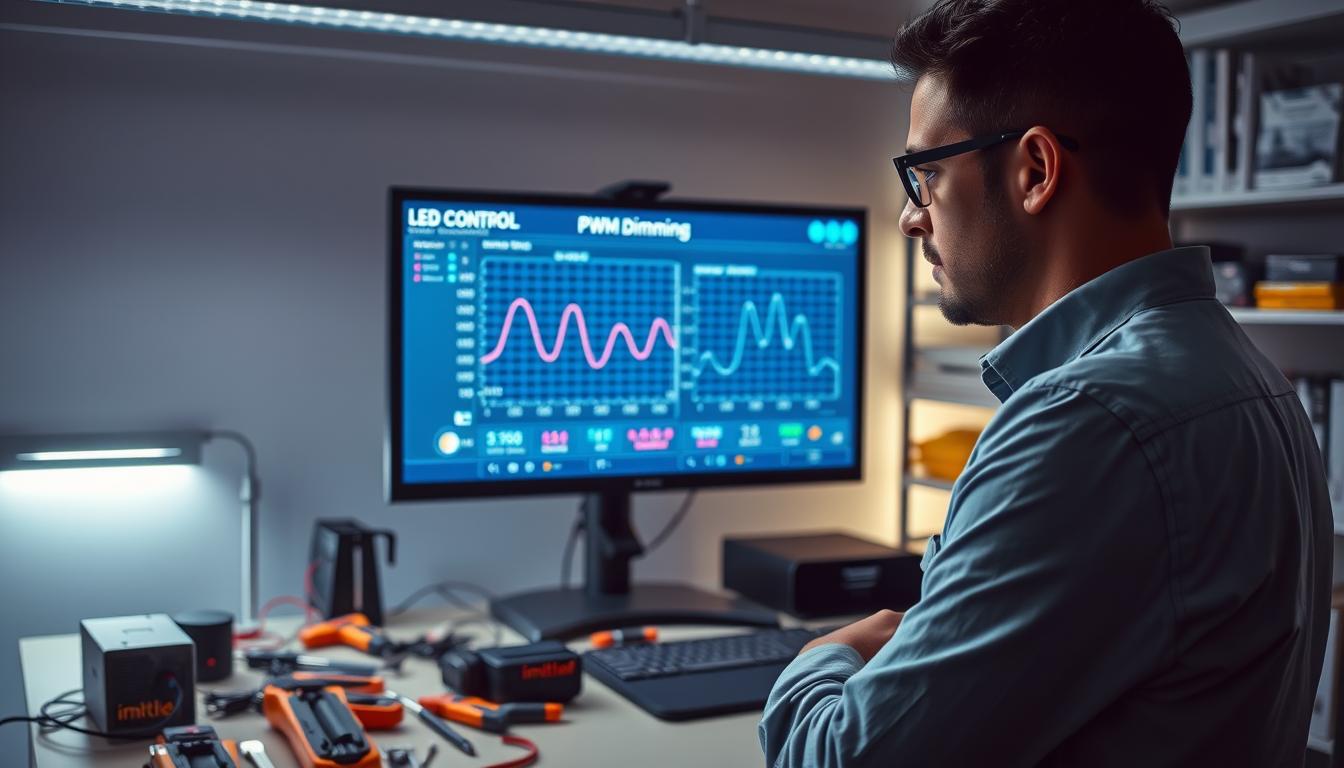
Achieving perfect illumination is usually simple, but sometimes technical challenges arise. We believe that choosing the right light setup is the first step toward a seamless experience. When your system does not perform as expected, a systematic approach helps identify the root cause quickly.
Whether you are dealing with minor fluctuations or persistent performance gaps, we are here to help. By understanding how your components interact, you can maintain a stable and reliable environment. If you are looking for a more streamlined way to manage your setup, consider our Variateur LED Wi-Fi pour plus de commodité lighting to simplify your daily adjustments.
Inconsistent Brightness Problems
Inconsistent brightness often stems from voltage drops across long cable runs. When the power supply cannot maintain a steady voltage to the end of the strip, the LEDs appear dimmer than those near the controller. Ensuring proper wire gauge is essential to prevent this drop.
- Check all physical connections for oxidation or loose contact.
- Verify that your power supply capacity matches the total load of your LED strips.
- Use shorter cable runs to maintain consistent voltage levels throughout the installation.
Flickering LEDs
Flickering is frequently caused by a mismatch between the PWM frequency and the driver capabilities. If the frequency is too low, the human eye may perceive the rapid switching as a strobe effect. Choosing the right light controller that supports high-frequency modulation can effectively eliminate this visual distraction.
Another common culprit is an incompatible dimmer switch. Always ensure that your controller is specifically designed for the type of LED load you are using. A stable power source is the foundation of a flicker-free environment.
Noise and Interference Solutions
The rapid switching cycles in PWM systems can produce electromagnetic interference (EMI) radiation. This occurs due to the quick-rising and falling edges of the switching signal, which may affect nearby electronic devices. Proper shielding and cable management are vital to minimize this noise.
To mitigate interference, keep your low-voltage control wires away from high-voltage AC lines. If you notice audible buzzing or signal degradation, consider these steps:
- Use twisted-pair wiring to reduce the loop area for EMI.
- Install ferrite beads on the power lines to suppress high-frequency noise.
- Ensure your controller is properly grounded to dissipate stray signals.
The Role of PWM in Energy Efficiency
When you prioritize sustainability, PWM dimming becomes an essential tool in your lighting design toolkit. By choosing the right light and the right control method, you can significantly lower your operational costs. We focus on creating systems that make energy management simple and effective for every user.
Reducing Power Consumption
PWM dimming works by rapidly switching the electrical current on and off. This process ensures that the LED only consumes power when it is actually emitting light. Because the system spends a portion of its cycle in an “off” state, the total power draw is drastically reduced compared to traditional dimming methods.
This efficiency does not mean you have to sacrifice brightness or quality. Our controllers allow you to maintain perfect illumination levels while keeping your energy usage at a minimum. It is a smart way to ensure your facility or home remains bright without wasting electricity.
Extending LED Lifespan
Heat is the primary enemy of any electronic component, especially high-performance LEDs. PWM dimming helps extend the lifespan of your lighting by lowering the average electrical current provided to the diodes. This reduction in current directly translates to less heat accumulation within the fixture.
By keeping the internal temperature lower, you prevent the premature degradation of the LED chips. This means your lights will last longer and require fewer replacements over time. We design our systems to prioritize this longevity, ensuring your investment provides reliable performance pour les années à venir.
Environmental Benefits of Efficient Systems
Adopting efficient lighting technology is a major step toward a greener future. Whether you are choosing the right light for a commercial space or a cozy living room, the flexibility of PWM is unmatched. You can easily adjust the output to achieve the perfect cool vs warm white light balance for any environment.
Lower energy consumption leads to a smaller carbon footprint for your home or business. By minimizing waste and maximizing the life of your hardware, you contribute to a more sustainable world. We are proud to offer solutions that help you save money while protecting the environment.
Innovations in PWM Dimming Technology
The landscape of LED control is evolving to meet the demands of today’s smart homes. We are constantly exploring new ways to integrate pulse width modulation into modern ecosystems to make your life easier. Our focus remains on simplicité et efficiency as we push the boundaries of what is possible.
Emerging Trends in Control Systems
Control systems are becoming significantly more sophisticated and interconnected. Modern hardware now allows for granular adjustments that were previously impossible in standard setups. By leveraging high-frequency PWM signals, we ensure that lighting transitions remain smooth and flicker-free.
These advancements allow for seamless communication between sensors and light sources. We prioritize systems that offer reliable performance even in complex, multi-room environments. This level of integration ensures that your home lighting responds instantly to your needs.
Smart Home Integration
PWM signals are increasingly used in smart home integration to provide precise control over your home ambiance. A key priority for us is maintaining an accurate light color temperature as these systems become more interconnected. Whether you prefer warm tones for relaxing or cool tones for working, our technology keeps the output consistent.
We believe that smart lighting should be intuitive and effortless. By syncing PWM controllers with voice assistants and mobile apps, you gain total command over your environment. This approche intelligente to lighting transforms how you interact with your living space every single day.
Future of PWM Dimming Applications
Looking ahead, we are committed to developing the next generation of lighting technology. We are currently testing new methods to enhance energy efficiency while preserving the quality of light color temperature across all dimming levels. Our goal is to provide solutions that are both powerful and incredibly simple to use.
We invite you to join us as we continue to innovate in this space. The future of lighting is bright, and we are excited to help you illuminate your dreams with cutting-edge control. Below is a summary of how modern PWM innovations compare to traditional methods.
| Fonctionnalité | Traditional PWM | Modern Smart PWM |
|---|---|---|
| Control Interface | Interrupteurs manuels | Application et contrôle vocal |
| Color Accuracy | Standard | High (Stable light color temperature) |
| System Integration | Isolated | Fully Interconnected |
| User Experience | Basique | Intuitive & Automated |
Case Studies: Successful PWM Dimming Implementations
We have witnessed how PWM dimming technology transforms ordinary spaces into extraordinary experiences. By integrating advanced control systems, we help designers achieve a level of visual sophistication that was previously difficult to reach. These real-world examples showcase the versatility of our solutions in various professional environments.
Enhancements in Retail Lighting
In the retail sector, the right atmosphere is essential for driving sales and improving customer comfort. Our clients often use PWM dimming to adjust the light color temperature, ensuring that products look their best under any conditions. By fine-tuning the output, stores can create a welcoming environment that encourages shoppers to linger longer.
- Dynamic highlighting of seasonal displays.
- Energy savings during off-peak hours.
- Consistent visual appeal across different store zones.
Enhancements in Public Spaces
Public areas require lighting that balances safety with aesthetic beauty. We have seen how precise control allows municipalities to manage Kelvin scale lighting effectively, shifting from bright, functional white light during the day to warmer, inviting tones at night. If you are looking to improve your own outdoor areas, you can égayez votre abri de voiture avec smart lighting that utilize these same principles.
Effective lighting management ensures that public parks and plazas remain accessible and secure. By using PWM, these spaces maintain a high quality of light without the flickering often associated with older dimming methods.
Success Stories in Modern Architecture
Modern architecture relies on light to define shapes and highlight structural features. Architects frequently use our PWM systems to manipulate light color temperature, allowing them to emphasize textures and materials in ways that static lighting cannot. This level of control is vital for creating dynamic architectural statements.
By mastering Kelvin scale lighting, designers can ensure that the building’s facade looks stunning at any hour. These success stories prove that when technology meets creativity, the results are truly remarkable. We are proud to support these visions with reliable, efficient, and innovative control solutions.
Regulatory Standards Impacting PWM Dimming
We believe that understanding regulatory standards is the foundation of every successful lighting installation. Navigating these requirements might seem complex, but our team simplifies the process to ensure your projects remain safe and efficient. By prioritizing compliance, we help you build systems that stand the test of time.
Safety Standards and Compliance
Safety remains our top priority when designing advanced lighting control systems. We ensure that all our PWM components meet rigorous electrical safety codes to protect your property and users. For instance, our Class 2 drivers are UL-certified, making them suitable for both moist and dry environments.
This certification provides a high level of assurance for various installation types. Whether you are lighting a bathroom or a living room, you can trust that our hardware is built to prevent electrical hazards. Reliability is at the heart of everything we do.
Environmental Regulations
Modern lighting must do more than just look good; it must also respect our planet. We strictly adhere to environmental regulations that limit hazardous materials and promote energy conservation. Our PWM dimming solutions are designed to minimize waste and maximize the lifespan of your LED fixtures.
- Compliance with RoHS directives to eliminate harmful substances.
- Adherence to energy-saving mandates that reduce overall grid demand.
- Support for sustainable manufacturing processes in all our control modules.
Industry Certifications and Labeling
Clear labeling and industry certifications act as a roadmap for quality assurance. When you select components for your project, these marks confirm that the equipment has passed independent testing. This is especially important when balancing the aesthetic needs of warm vs cool lighting in a professional space.
We provide detailed documentation for all our products to simplify your inspection process. Choosing certified equipment ensures that your transition between warm vs cool lighting remains smooth and flicker-free. Your peace of mind is our ultimate goal as we continue to innovate within the regulatory landscape.
Conclusion: The Future of LED Control and PWM Dimming
Precision lighting transforms how we experience our environments. By adopting LED PWM dimming, you gain total command over your space. This technology ensures your lights perform exactly as intended while maintaining peak energy efficiency.
Refining Your Lighting Experience
We believe that high-quality light should be accessible to everyone. Whether you are balancing warm vs cool lighting for a cozy home or a productive office, our systems provide the stability you need. You can achieve perfect ambiance without sacrificing performance or color accuracy.
Partnering for Future Success
Our team is ready to support your next project with reliable and innovative solutions. We invite you to reach out to us at [email protected] to discuss your specific requirements. You can also visit our website at www.imltled.com or send a message to our team on WhatsApp at 0086 185 8848 3178. Let us help you create a brighter and more efficient world today.