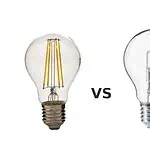
Do you know every bulb has a specific code that defines its shape and size? This number has an initial letter that indicates the shape, followed by a number defining its size. Besides, the base of the bulb also has definite codes.
In this guide, we will learn about the shapes and sizes of light bulbs and find which is best for your application:
Hide
How Do I Know the Shape & Size of My Light Bulb?
You can know the shape and size of the bulb by their bulb code. Light bulbs have a code indicating their shape and size. It has two parts- ‘letters’ and ‘numbers’. The letter indicates the shape or type of the bulb, whereas the number defines the diameter of the widest part of the light.
For example, when you hear of a G25 bulb, the letter ‘G’ refers to its globe shape, and the number ‘25’ defines the diameter of the widest part of the bulb. It is measured as ‘eighths of an inch’. The diameter of the G25 bulb is 25/8th of an inch or 3.125 inches ( ~79mm).
Basics To Understand Bulb Shape, Sizes & Condes
When purchasing any bulb, don’t get puzzled seeing variations of bulb codes and terms. Below, I am adding all the necessary terms that will guide you in picking the ideal bulb size and shape for your application:
Common Bulb Code (Letter) For Bulb Shapes
The bulb codes are initiated by one or two letters indicating the shape of the bulb. Check the table below to understand what these letters mean and the application of these bulbs:
| Code | Shape | Description | Common Uses |
| A | Pear-shaped | Rounded top, slightly tapered base | General home and office lighting |
| B | Bullet | Small, narrow, and tapered | Chandeliers, pendant lighting, decorative fixtures |
| BR | Short Reflector | Shorter, wide-angle reflector bulb | Recessed lighting, floodlights |
| C | Candle | Slim with a flame-like tip | Chandeliers, wall sconces, decorative lighting |
| R | Reflector-shaped | Slightly rounded front with a built-in reflective coating | Recessed lighting, track lighting, spotlights |
| ER | Extended Reflector | Similar to R bulbs but with an extended shape for a wider beam | Recessed and track lighting |
| G | Globe | Large, round shape | Vanity mirrors, pendant lights, and decorative lighting |
| T | Tubular | Long and cylindrical | Picture lights, vintage fixtures, appliance lighting |
| LFL | Linear Fluorescent Lamp | Long, straight tube, commonly used in series | Commercial lighting, office lighting, and industrial applications |
| MB | Halogen Bulb | Small, high-intensity bulb with a halogen gas fill | Projectors, automotive lights, and floodlights |
| MR | Multifaceted Reflector (Quartz Reflector Lamp) | Small, multifaceted, focused beam | Track lighting, landscape lighting, display lighting |
| PAR | Parabolic Reflector | Deep reflector for intense, focused lighting | Outdoor floodlights, stage lighting, and sports fields |
Common Bulb Code (Number) For Bulb Sizes
The bulb size determines the diameter of the widest section. It is measured in eighths of an inch. For example, the bulb code with the number ‘11’ means the diameter of the widest part is 11/8th of an inch. Mathematically, it stands as-
11 x (⅛) = 11/8 inches or 1.375 inches
Go through the chart below to find out the common bulb code and their diameter in inches and millimeters:
| Bulb Code (Number) | Diameter (Inches) | Diameter (Millimeters) |
| 8 | 1 inch | 25.4 mm |
| 11 | 1.375 inches | 34.93 mm |
| 16 | 2 inches | 50.8 mm |
| 20 | 2.5 inches | 63.5 mm |
| 30 | 3.75 inches | 95.25 mm |
| 38 | 4.75 inches | 120.65 mm |
Common Bulb Code For Bulb Base
The bulb code for the bulb base is different from that of codes that indicate shape and size. Bulb base code refers to the type of socket connection the bulb uses. Similar to the shape and size code, the base code also includes two sections- a letter and a number; for example, E26.
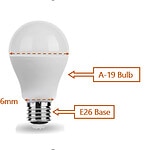
The letter of the bulb base code indicates the base type, and the numerical section refers to the base diameter in diameter in millimeters. For example- an A19 E26 means a standard A19-shaped bulb with an E26 screw base. Here ‘E’ refers to the Edison screw bulb, and the number ‘26’ indicates its diameter of 26mm.
| Bulb Code | Base Type | Base Diameter | Common Uses |
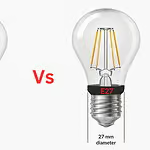
| E26/E27 | Standard-Medium Edison | 26mm (E26) / 27mm (E27) | Household bulbs (e.g., A19), standard in North America (E26) and Europe (E27) |
| E12 | Candelabra | 12mm | Decorative lighting, chandeliers, and small fixtures |
| E17 | Intermediate | 17mm | Slightly larger than E12; used for ceiling fans, small appliances (microwaves, refrigerators), and decorative lights. |
| G4 | Bi-pin | 4mm (pin spacing) | Two-pin base for smaller halogen bulbs, often used in under-cabinet and landscape lighting. |
| GU10 | Twist-and-Lock | 10mm (pin diameter) | Spotlights, track lighting (residential and commercial) |
| GU24 | Bi-pin | 24mm (pin diameter) | A two-pin base for compact fluorescent bulbs, energy-efficient lighting solutions. |
| T5 | Fluorescent Tube | ⅝ inch (15.875mm) | Slimline fluorescent fixtures are used in kitchens, bathrooms, and under-cabinet lighting |
| T8 | Fluorescent Tube | 1 inch (25.4mm) | Base for T8 fluorescent tubes, commonly used in office and retail lighting. |
Bulb Types Based On Shape & Size
1. Type A Bulbs
The letter ‘A’ stands for ‘Arbitrary’ (or Classic) shape bulbs. These bulbs are the most common bulbs that come in ‘shape and are designed for standard household applications. These lights are compatible with medium screw bases, E26 or E27.
Common Sizes:
| A Type Bulb Code | Diameter (Inches) |
| A15 | 1.875 inches |
| A19 | 2.375 inches |
| A21 | 2.625 inches |
| A25 | 3.125 inches |
A19 is the most common and widely used A-type bulb. This is considered ideal for a household having a diameter of 2.375 inches (or 60mm). You can use these bulbs in table lamps, ceiling fixtures, floor lamps, and pendant lighting.
2. Type B & C Bulbs
The type B and C types bulbs are mostly used for decorative lighting. The B-type bulb has a bullet-like shape. In contrast, type C bulbs have a longer body with a pointed tip that looks like a candle flame.
Common Sizes:
| Type | Bulb Code | Diameter (Inches) |
| B | B10 | 1.25 inches |
| B11 | 1.375 inches | |
| B13 | 1.625 inches | |
| C | C7 | 0.875 inches |
| C9 | 1.125 inches | |
| C10 | 1.375 inches | |
| C15 | 1.875 inches |
The common bases used in B and C-type bulbs are – E26/E27, E12, and E17. This makes type B and C bulbs ideal for chandeliers, wall sconces, pendant lights, outdoor lanterns, decorative lamps, and holiday lights.
3. Type G Bulbs
Type G bulbs are globe-shaped bulbs popular for modern lighting. These bulbs spread light in all directions, similar to type-A bulbs. G bulbs are most commonly used in vanity lighting surrounding the mirror. Besides, you can use these lights in pendant lights, ceiling fixtures, and decorative lighting.
Common Sizes
| G Type Bulb Code | Diameter (Fraction) |
| G11 | 1.375 inches |
| G14 | 1.75 inches |
| G16/G50 | 2 inches |
| G25 | 3.125 inches |
| G30 | 3.75 inches |
| G60 | 7.5 inches |
| G80 | 10 inches |
4. Type BR Bulbs
The letters ‘BR’ stands for “bulged reflector” as they come with an inner reflector. These lights are designed for wider beam angles, as used in floodlights. If you want a soft and diffused light, BR bulbs are your go-to option; they offer beam angles greater than 100 degrees. Besides flood lights, you can use BR bulbs in recessed, track, and outdoor security lights.
Common Sizes
| BR Type Bulb Code | Diameter (Inches) |
| BR20 | 2.5 inches |
| BR30 | 3.75 inches |
| BR40 | 5 inches |
However, the performance and lifespan of the BR bulb are greatly impacted by the installation style. When you install BR bulbs horizontally, it builds up the heat on the base, which overheats the bulb. This leads to flickering and early failure of the bulb. This is why a vertical installation is always preferred for BR bulbs.
5. Type PAR Bulbs
The term PAR stands for “Parabolic Aluminized Reflector”. These bulbs are similar to BR lights as they also have reflectors, but are designed for outdoor use. However, PAR bulbs give more focused lighting and have a narrower beam angle compared to BR bulbs. The common bulb bases used in PAR bulbs are- E26/27 and G53 screw pin bases. Besides, they run under high wattage, making them suitable for outdoor and other applications where bright illumination is needed.
Common Sizes:
| PAR Type Bulb Code | Diameter (Inches) |
| PAR16 | 2 inches |
| PAR20 | 2.5 inches |
| PAR30 | 3.75 inches |
| PAR36 | 4.5 inches |
| PAR38 | 4.75 inches |
Similar to BR bulbs, the lifespan and beam spread of PAR bulbs are also affected by orientation.
6. Type MR Bulbs
MR refers to the multifaceted reflector used in these bulbs. These bulbs are highly used in spotlighting commercial and residential areas. The reflector inside these bulbs controls the beam angle to produce a highly directional illumination. Besides spotlights, MR bulbs are also used in recessed lighting, track lighting, desk lamps, and display cases.
Common Sizes:
| MR Type Bulb Code | Diameter (Inches) |
| MR8 | 1 inch |
| MR11 | 1.375 inches |
| MR16 | 2 inches |
| MR20 | 2.5 inches |
These lights are available in both high and low-voltage variants. For low-voltage AC/DC systems, MR bulbs require a GZ4 bi-pin base. In contrast, a high-voltage 120V system needs a GU10 bi-pin base.
7. Type LFL and T Light Bulbs
The LFL and T lights are the two most popular variants of fluorescent light widely used for general lighting. The LTL refers to the ‘Linear Fluorescent Lamps’, and T lights refer to tubular fluorescent lights. These lights are mostly designed for indoor lighting. When it comes to measuring the size of these lights, you must consider their length along with their diameter.
Common Sizes:
| Bulb Type | Bulb Code | Common Lengths | Diameter |
| LFL | T5 | 2′, 3′, 4′, 5′, 6′ | 5/8 inches (0.625″) |
| T8 | 2′, 4′, 6′, 8′ | 8/8 inches (1 inch) | |
| T12 | 2′, 4′, 6′, 8′ | 12/8 inches (1.5″) | |
| T | T7 | 2′, 3′, 4′, 6′ | 7/8 inches (0.875″) |
| T8 | 2′, 3′, 4′, 6′ | 8/8 inches (1 inch) | |
| T10 | 2′, 3′, 4′, 6′ | 10/8 inches (1.25″) | |
| T12 | 2′, 4′, 6′, 8′ | 12/8 inches (1.5″) | |
| T14 | 2′, 4′, 6′ | 14/8 inches (1.75″) |
Besides these, there are many specialty variants of fluorescent lights used in appliances or industrial settings. For instance, High Output (HO) Fluorescent Bulbs are used in warehouses and factories; U-shaped fluorescent bulbs are used in refrigerators and freezers. Again, circline fluorescent bulbs are used in industrial settings where space is limited
How To Choose the Right Shape & Size Of Your Bulb?
Consider Lighting Needs
You must choose the light size considering its application. For instance, if you choose a small bulb for general lighting, it won’t serve the purpose. In this case, A19 bulbs work best; it is the standard size for household lighting. You can use these lights to illuminate your bathroom, office room, or other spaces for ambient lighting.
Again, for decorative lighting, B and C-type bulbs are popular choices. You can use them in chandeliers, pendant lights, and more. However, for outdoor lighting, where highly focused and bright lighting is required, go for PAR lights.
| Lighting Needs | Bulb Shape |
| General/Decorative (versatile) | A-shape |
| General | G-shape |
| Decorative | B & C-shape |
| Task & Accent | PAR |
Measure Fixture Space
Considering the fixture space is a must to ensure the physical size of the bulb fits the enclosed or recessed fixtures. Measure the length and diameter of the fixture to figure out the right bulb size. Make sure the bulb is neither too big nor too small than the space inside the fixture.
For example, if the diameter of the fixture is 2.5 inches, choose an A19 bulb that has a maximum 2.375-inch diameter. This will fit perfectly within the fixture.
Size vs Wattage: Which is More Important?
Wattage defines the power consumption of the light. Usually, larger bulbs are considered to be of higher wattage, that gives brighter illumination. Though this is justified for traditional halogen or incandescent bulbs, the case is not the same with modern LED lights.
LEDs run on low wattage and can bring equivalent light output as a high-wattage traditional fixture like incandescent. For example, a 12W LED light will give equal brightness as a 60W bulb. So, you can replace a high-wattage incandescent bulb easily with a low-wattage LED.
Therefore, while purchasing light bulbs, don’t just assume their power consumption by size; instead, consider lumen output for that definite wattage rating.
Consider Bulb Base Type
The bulb base can be of different types. If your bulb base doesn’t match the socket, it won’t fit in. This is why, before purchasing any bulb, check what type of socket you have. If it’s a screw base socket, purchase a bulb with E26, E27, or E12 base. And if it is a bi-pin base socket, choose G-series bulbs like- G4, G5.3, GU10, or G13. Besides screw and bu-pin sockets, other socket variants are also available. For instance, B22 bulbs are designed for bayonet bases.
However, while selecting bulb bases, you must consider lighting standards for your region. For instance, in the U.S., E26 is considered the standard screw base, which works at 120V. In contrast, in Europe, E27 is the standard screw base that operates at 240V.
Light Technology: Consider Energy Efficiency and Lifespan
Light bulbs are available in different technologies, such as incandescent, halogen, CFL, and LED. Compared to all these light bulbs, LED is the most energy-efficient variant. It uses 90% less energy than incandescent light but provides equivalent light output. Besides, they also have a greater lifespan than other bulb types, 50 times longer than incandescent.
| Light Bulb Type | Lifespan |
| Incandescent | 750 – 2,000 hours |
| Halogen | 2,000 – 4,000 hours |
| CFL (Compact Fluorescent Lamp) | 8,000 – 15,000 hours |
| LED (Light-Emitting Diode) | 50,000 hours |
Other Factors To Consider
1. Color
While picking the light color of your bulb, consider its application. If you are using the bulb for general lighting, go for a warm or cool white bulb as per your preference. However, bulbs are also available in multiple colors like- red, blue, yellow, orange, and more. These colorful bulbs are widely used in decorative and holiday lighting. For instance, red and green C-type bulbs are most popular for Christmas lighting.
2. Dimming
Having a dimmable light allows you to use the same general lighting bulb as a night light. Wanna know how? Dimmable lights allow you to adjust the light intensity. As a result, while sleeping, you can dim the light and sleep peacefully. Besides bedroom lighting, dimmable bulbs also facilitate flexibility for all types of applications.
However, it is worth noting that incandescent and halogen bulbs are dimmable by nature. But this is not the same for LEDs. LED bulbs require dimming compatibility to use them with a dimmer switch. So, before purchasing LED bulbs, go through the specifications to ensure it is dimmable.
3. Smart Technology Compatibility
Having smart technology integration brings you advanced features in your light bulbs. However, all bulb types don’t integrate with smart technology. A19 and BR30 are the most popular smart lighting types. You can control these lights via apps and voice assistants like Alexa or Google Assistant. This way, they allow you to add smart lighting to your house.
4. Aesthetics and Design Trends
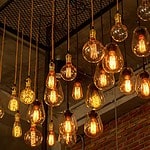
Earlier bulbs were mostly fit in enclosed fancy fixtures. But bare bulbs with visible filaments are now used as a statement piece. For instance, using an exposed A19 bulb, you can bring a vintage and rustic vibe to your space. This design trend is quite popular in restaurant lighting and creating aesthetic corners.
5. Environmental Impact
To ensure sustainability, always prefer an environment-friendly lighting option. Fluorescent lights contain toxic elements like mercury, which are harmful to the environment. In contrast, LED lights have fewer toxic elements and can be easily recycled. These bulbs also last longer, which reduces waste.
LEDs further don’t produce heat as incandescent bulbs. Where incandescent emits 80% of energy as heat, LED emits only up to 20%. This makes LED highly energy-efficient and suitable for green energy.
6. Cost Considerations
Though the initial cost of an incandescent bulb is lower than LED or CFL bulbs, they are expensive in the long run. This is because incandescent bulbs consume greater energy, which leads to high electricity bills. Besides, they have a short lifespan, so you should replace the bulb soon with a new one.
In contrast, LED lights need a high upfront cost; they last about 25% longer than incandescent bulbs. Besides, due to its high energy efficiency, LEDs will save your electricity bills by many times. Thus, considering the overall constant, LED bulbs are a win-win deal.
Differences Between PAR30 vs BR30
PAR30 and BR30 LED lights are green solutions for interior and exterior lighting. Though they have many physical similarities, the major differences are as follows:
| Feature | PAR30 | BR30 |
| Definition | PAR30 bulbs are Parabolic Aluminized Reflector bulbs with a diameter of 3.75 inches, offering a focused beam. | BR30 bulbs are Bulged Reflector bulbs of 3.75-inch diameter, designed for a wide flood beam. |
| Beam Angle | 5 to 45 degrees | 100 degrees plus |
| Light Output | Sharp and directional illumination | Softer, more even illumination |
| Best Used For | • Outdoor security lights • Retail displays • Recessed lighting with precise beam control |
• Indoor recessed lighting • Ambient lighting • Living rooms • Kitchens |
Differences Between A19 & BR30
| Feature | A19 | BR30 |
| Shape | Classic pear-shaped design | Wider, bulged shape with a built-in reflector. |
| Beam Angle | Omnidirectional (360°) – Light spreads in all directions. | Wide Flood (100°+) – Soft, diffused light focused downward. |
| Light Output | Spread light evenly in all directions. | More concentrated light downward, ideal for recessed fixtures. |
| Common Applications | Lamps, fan lights, sconces, and ceiling fixtures | Recessed ceiling lights, floodlighting, track lighting |
How to Read Light Bulb Labels and Codes?
When purchasing any light bulbs, irrespective of shape and size, you must consider some factors to have an idea of the light output. Here are some specifications to go through:
Wattage
The wattage refers to the energy consumption of the bulb. Low wattage means the bulb uses less energy to illuminate. LED lights run under low wattage but offer higher brightness. For instance, a 10W LED can replace a 60W incandescent bulb.
Lumens
A higher lumen means brighter light. Consider your application and look for the appropriate lumen rating. You will find the brightness is written as lumen or lm.
CRI
CRI refers to the ‘Color Rendering Index’. It determines the color accuracy of the light compared to natural lighting. Higher CRI means better color accuracy.
Color Temperature
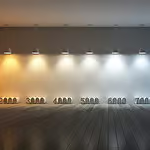
Color temperature defines the hue of the light color. It is measured in the Kelvin (K) scale. CCT usually ranges from 2200K to 6500K; lower CCT means warm light, and higher CCT means cool light.
Energy Star Rating
The ENERGY STAR label is a certification offered to lightings that meet strict energy efficiency standards. So, if you find this label in the bulb packaging, this indicates the lights are highly energy-efficient.
Industry-Standard Codes
Different international organizations set standards to ensure light quality, safety, and performance. Fixtures that fulfill these standards are certified by the organization. The most important lighting standards include the following:
| Standard | Deals With |
| IEC 60598 | General safety and performance requirements for luminaires. |
| ASHRAE/IES 90.1 | Energy efficiency standards for building lighting. |
| IECC (International Energy Conservation Code) | Energy code for residential and commercial buildings. |
| ANSI/IESNA RP-1-04 | Recommended office lighting practices for computer-based workspaces. |
| OSHA Lighting Standards | Workplace lighting safety requirements. |
| LM-79 | Testing standard for LED lighting performance. |
| LM-80 | Testing standard for LED lumen maintenance over time. |
Other important certifications to consider include- UL, ELT, CB, CE, RoHS, etc. This ensures the light is well tested and manufactured, maintaining international standards.
FAQs
The Bottom Line
While choosing lighting for your home, check out the bulb code and base type for a perfect fit. If you are looking for general lighting bulbs, Type A, G, or BR lights work great. Besides, LED tubes or linear lights are also popular for this purpose. For decorative lighting, B and C types are widely used variants; they are available in different sizes and colors and are ideal for holiday lighting.
However, if you want sleek lighting for your home, LED strips are your go-to choice. Unlike light bulbs, they have a flexible and flat-thin body that you can cut to define size. Whether it’s general, accent, or decorative lighting, these fixtures work great. So, to give your house a modern look, choose the top-quality LED strips from LEDYi and take your interior and exterior lighting to the next level!