Buried electrical wiring has different requirements than regular wiring as it deals with underground moisture, pressure, and force. The regular NM-B wire that we use for residential use is not suitable for outdoor burial wiring. That is why it is crucial to follow the NEC code for safe and secure outdoor burial electrical wiring. In this guide, we will discuss the code in detail:
Hide
What Is the NEC Code? – The Basics
The National Electrical Code (NEC) or NFPA 70 is a national standard that includes detailed guidelines for the safe installation of electrical systems in the U.S. These guidelines are published by the National Fire Protection Association (NFPA). The standard covers wire types, minimum depth, voltage, backfilling, and other necessary recommendations for secure electrical wiring. Thus, by following the NEC code, you can prevent your instruments from shocks, electrical fires, and other hazards.
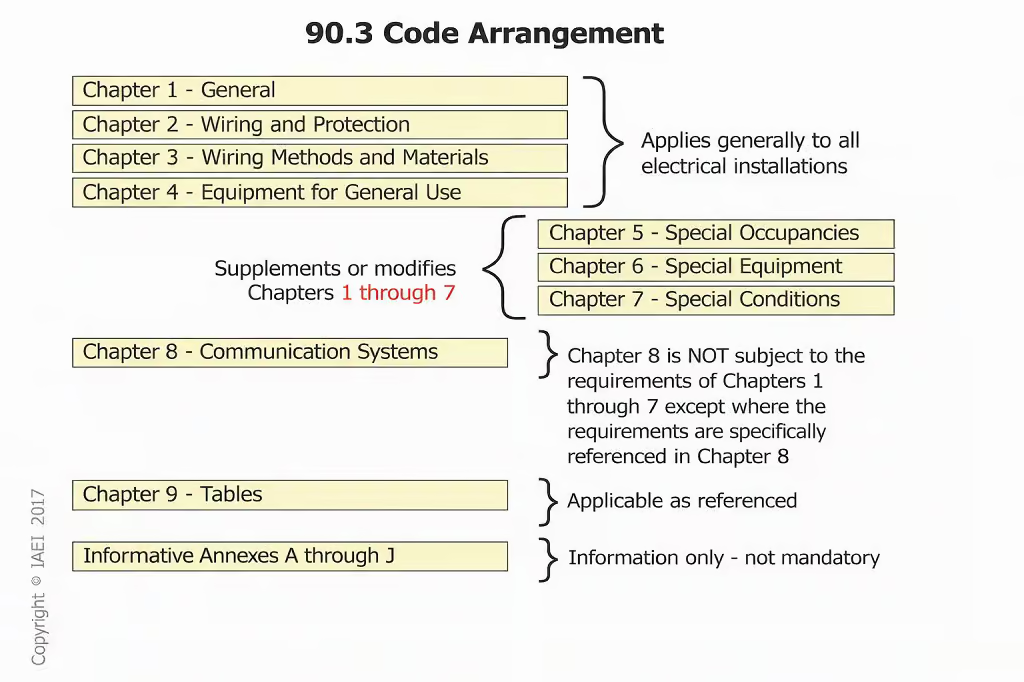
NEC code is applied to almost all electrical work in the U.S. However, the NEC is mandated by many jurisdictions outside the U.S. It includes electrical systems, wiring, construction, lighting, and more. There are nine chapters in the NEC that are divided into articles, parts, and sections. Besides, the code includes an introduction section at the beginning and concludes with an informative index. The structure of the NEC is as follows:
| NEC Structure |
| Introduction |
| • Chapter 1: General • Chapter 2: Wiring and Protection • Chapter 3: Wiring Methods and Materials • Chapter 4: Equipment for General Use • Chapter 5: Special Occupancies • Chapter 6: Special Equipment • Chapter 7: Special Conditions • Chapter 8: Communications Systems • Chapter 9: Tables |
| • Annex A: Product Safety Standards • Annex B: Application Information for Ampacity Calculations • Annex C: Conduit, Tubing, and Cable Tray Fill Tables… • Annex D: Examples • Annex E: Types of Construction • Annex F: Critical Operations Power Systems… • Annex G: Supervisory Control and Data Acquisition (SCADA) • Annex H: Administration and Enforcement • Annex I: Recommended Torque Tables… • Annex J: ADA Standards for Accessible Design • Annex K: Use of Medical Equipment in Dwellings… |
NB: NEC code doesn’t apply to any kind of electrical system of automotive vehicles, ships, or aircraft.
A Brief History of the Early NEC
The early history of NEC is related to the late 1800s. Back then, several organizations like the New York Board of Fire Underwriters and the National Electric Light Association published separate electrical rules. But the emergence of multiple standards was creating confusion, and there was a need for a unified standard.
With the intention of setting a standard, a collective meeting was arranged in March 1896 in New York City. This gathering was named the “Joint Conference of Electrical and Allied Interests,” where expertise and associations of different fields, like insurance, electrical, architectural, and representatives from related fields, were present. This board later published the National Board of Fire Underwriters Pamphlet 70 (NBFU 70) in 1897. This pamphlet is mainly the first edition of the National Electrical Code.
Later in 1911, the standard was periodically revised and published as a new edition. Besides, this documentation was transferred to the National Fire Protection Association. NFPA has been managing the upgrade, revision, and extension of the NEC. At present, the NEC code is regarded as the most used and reliable standard set by NFPA.
Importance of Following the NEC Code for Safety
NEC is a widely recognized and American National Standards Institute (ANSI) approved code. It ensures the safety of electrical installation on personal and industrial properties. This is why, to keep the electrical installations safe, it is crucial to follow the NEC Code. From this code, you get the guidelines about the following:
- Rules for electrical installations, including voltage, connection, and more.
- Wiring and protection guidelines
- Method and materials for wiring based on application; this covers conductors, cables, raceways, conduits, and boxes.
- Use of electrical equipment
- Special application guidelines for hazardous areas, aircraft, healthcare, and more.
Thus, by addressing the NEC code, you can get a safe and secure electrical installation. Besides, it also covers the legal aspects of burial electrical wiring.
Furthermore, the code is revised and updated every three years. This way, you can rely on the code as it keeps updating with the latest technology.
N.B.: Once the NEC code is updated, all states don’t have to implement it immediately. You can have a few months to a year to adapt to the latest version. Besides, the states can include or exclude specific sections of the code by considering their requirements.
Installation Guidelines for Outdoor Buried Electrical Wires
Outdoor Receptacles
In the code NEC 406.9(B)(1), it is declared that the receptacles of 15- and 20-amperes, 125- and 250-volts installed in a wet location shall have an enclosure. Whether the plug cap is attached or not, it applies to all such receptacles. This keeps the installation safe from shock and sudden accidents.
Again, according to the instruction of NEC 406.9(A), the outlet covers in wet areas have to be extra-duty listed and should open at least 90° on a hinge. If you find the design of the clover doesn’t allow a 90-degree opening, then set it in a way that allows a full opening.
Moreover, outdoor receptacles are mandatory for both the front and back of the house for single-family homes. And in this case, the installation height must not exceed 6.5 feet above the ground.
GFCI Requirements for Outdoor Use
GFCI stands for Ground-Fault Circuit Interrupter. It is an electronic safety device that offers protection against shock and electrical fire. This GFCI protection is essential for outdoor receptacles with 125V or 250V ratings as stated in NEC 210.8(A). Apart from outdoor areas, this obligation applies to the following areas:
- Bathrooms
- Garages
- Crawl spaces
- Kitchen
- Bathtub or shower stalls
- Laundry areas
- Unfinished portions or areas of the basement not intended as habitable rooms
- Temporary outdoor wiring and outlets near water sources, such as pools or fountains
GFCI Requirements Table
| NEC Article | Instruction on GFCI |
| 210.8(A)(3) | All outdoor outlets in dwelling units (up to 250V) must have GFCI protection. |
| 210.8(B) | GFCI is mandatory for all outdoor receptacles in commercial, industrial, and other non-dwelling locations |
| 590.6(A) | This article mandates GFCI protection for the temporary wiring of outdoor receptacles. It is often applicable to construction sites and temporary equipment. |
Conduits & Wiring
While using wiring for direct burial, you must ensure that the cables are labeled as UF cable for high voltage or are specialized for low-voltage lighting. High-voltage circuits, such as 120/240V-rated ones, can’t share the same conduit as the low-voltage ones, such as 12/24V. However, they can share a trench only if each circuit is in a separate conduit.
Considering the material of the conduits is also crucial here for safety. For instance, rigid metal, PVC, or IMC protects underground wires from damage and offers extensive mechanical protection, especially in shallower burial depths. According to NEC Article 300.5, the minimal cover requirements vary for different cable types; these are as follows:
| Type of Wiring | Minimum Cover |
| UF (Underground Feeder) Wire | 24 inches |
| PVC Wire | 18 inches (standard) |
| Galvanized Steel Wire | 6 inches |
| Low-Voltage Wiring | 6 inches |
| Rigid Metal Conduit (RMC) | 6 inches |
| Intermediate Metal Conduit (IMC) | 6 inches |
| Electrical Metallic Tubing (EMT) | 18 inches |
| Flexible Metallic Tubing (FMT) | 18 inches (standard) |
| Other Direct Burial Cables | 18 inches (standard) |
Moreover, according to the NEC codes, all wiring and connections should be secured by waterproof or weatherproof junction boxes to prevent moisture ingress and corrosion.
Minimum Cover Requirements
The term ‘Cover’ refers to the distance from the top of the buried wire to the ground surface. However, you must remember that ‘cover’ is not the total trench depth. In the NEC article 300.5, we find the minimum cover recommendation for wiring methods and raceways from zero to 1000 volts.
Note: The overall depth of the trench must be deeper than the minimum cover requirements for proper cover over the top of the wiring.
For direct buried cable or raceways, NEC E3803.1. [300.5(A)] provides the following table showing minimum cover requirements:
| TABLE E3803.1 (Table 300.5)MINIMUM COVER REQUIREMENTS, BURIAL IN INCHES | |||||
| LOCATION OF WIRING METHOD OR CIRCUIT | TYPE OF WIRING METHOD OR CIRCUIT | ||||
| 1 Direct burial cables or conductors | 2 Rigid metal conduit or intermediate metal conduit | 3 Electrical metallic tubing, nonmetallic raceways listed for direct burial without concrete encasement or other approved raceways | 4 Residential branch circuits rated 120 volts or less with GFCI protection and maximum overcurrent protection of 20 amperes | 5 Circuits for control of irrigation and landscape lighting are limited to not more than 30 volts and are installed with Type UF or in other identified cable or raceway | |
| All locations not specified below | 24 | 6 | 18 | 12 | 6 |
| In a trench below 2-inch-thick concrete or equivalent | 18 | 6 | 12 | 6 | 6 |
| Under a building | 0 (In raceway only or Type MC identified for direct burial) | 0 | 0 | 0 (In raceway only or Type MC identified for direct burial) | 0 (In raceway only or Type MC identified for direct burial) |
| Under a minimum of 4-inch-thick concrete exterior slab with no vehicular traffic, and the slab extending not less than 6 inches beyond the underground installation | 18 | 4 | 4 | 6 (Direct burial)4 (In raceway) | 6 (Direct burial)4 (In raceway) |
| Under streets, highways, roads, alleys, driveways, and parking lots | 24 | 24 | 24 | 24 | 24 |
| One- and two-family dwelling driveways and outdoor parking areas and used only for dwelling-related purposes | 18 | 18 | 18 | 12 | 18 |
| In solid rock where covered by a minimum of 2 inches of concrete extending down to the rock | 2 (In raceway only) | 2 | 2 | 2 (In raceway only) | 2 (In raceway only) |
Low-Voltage Systems
NEC article 725 classifies the power-limited circuits into three classes. These are as follows:
- Class 1: Can be power-limited or non-power-limited and can operate up to 600V.
- Class 2: Systems that operate up to 150V with limited power; usually ≤100VA)
- Class 3: Covers circuits which operate up to 150V or 100VDC
As per the NEC code, the low-voltage power supplies and electrical wiring are in Class 2 compliance.
You will find the necessary instructions for low-voltage lighting in Chapter 4 of the NEC. And according to NEC article 411, the low-voltage lighting systems are limited to 30V RMS or less and current to 25A max. Besides, low-voltage systems require specific wiring, connections, and installation rules. For instance, pool, spa, and fountain lighting of ≤30V is allowed to have a 6-inch depth.
Backfill Guidelines
Backfilling is important to ensure the wiring remains firm when buried. The NEC code suggests trench backfilling materials that are free of rock, sharp particles, or corrosive objects. Sand is an ideal backfilling material; however, depending on the application requirement, the backfilling material may vary.
The NEC 40 fill rule specifies the maximum percentage of conduit filling. These are as follows:
- For one conductor, the maximum fill = 53% of the space in the conduit
- For two conductors, the maximum fill = 31% of the space in the conduit
- For more than two conductors, the Max fill = 40% of the conduit
Protecting Buried Electrical Wiring from Damage
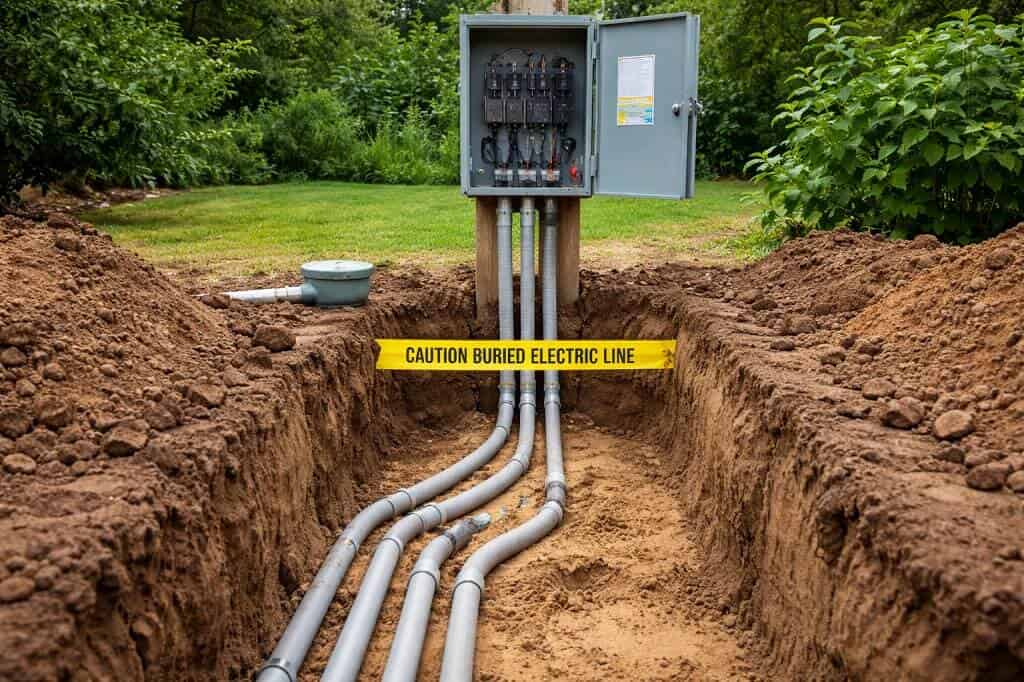
For protection, at least 8 feet of the cable coming from the underground should be covered by an enclosure. This will protect the wiring from any physical damage. Moreover, the two ends of the conduits must be sealed. As a result, the conduit will remain safe from water or moisture contact.
Marking Underground Electrical Wiring for Safety
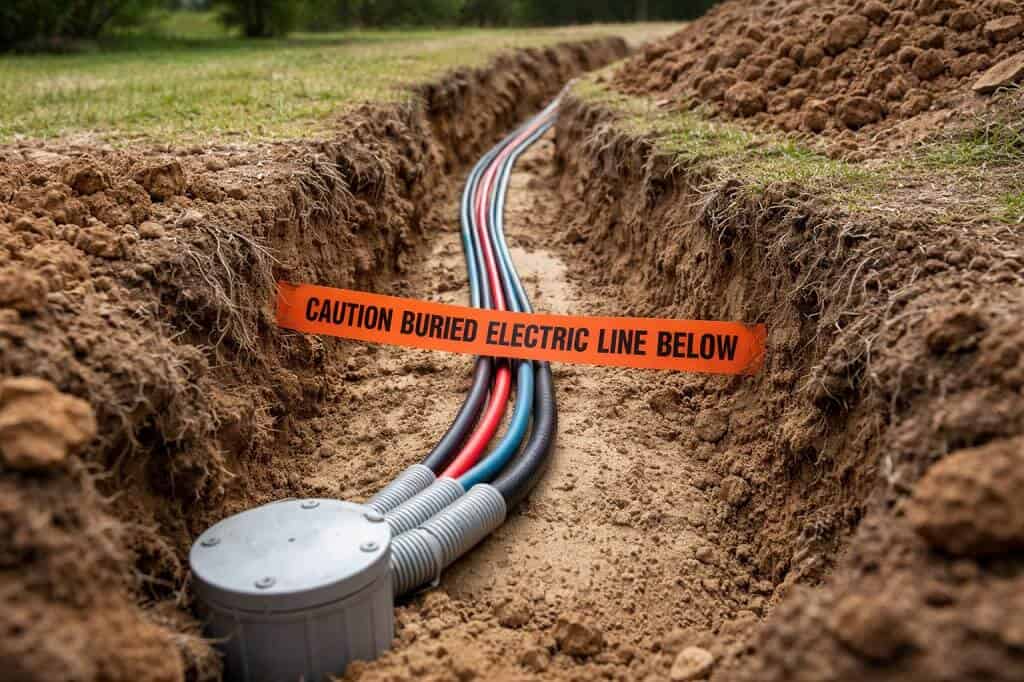
According to NEC code 300.5(D)(3), you must use the warning labels or ribbons 18 inches (or more) below grade. However, labels must not be put less than 12 inches above the installation.
Now, you may ask why such labeling is required? Basically, the labels work as signage or a warning. When anyone is digging the area, the ribbons provide them with a visual of the existence of electrical wiring. As a result, the digger becomes conscious and thus can be safe from electrical shock or any accident.
Four Burial Depth Options and Their Applications
Six-Inch Depth
Low-voltage wiring (below 30V) should be buried at a minimum depth of 6 inches. This depth is also applicable to galvanized metal electrical conduits. Common cases include the following:
- Landscape light
- Pool lighting
- Spa lighting
- Fountain lighting
Twelve-Inch Depth
According to the NEC table E3803.1, a 12-inch depth is one of the common recommended depths for direct burial electrical wiring. It offers a balance between sufficient safety and easy maintenance. Residential and landscape light wiring usually follows a 12-inch depth wiring.
Eighteen-Inch Depth
For PVC conductors or other nonmetallic raceways, the minimum depth suggested is 18 inches. This depth is suggested considering the stability and safety of the installation.
Twenty-Four Inch Depth
In the U.S., the minimum depth for direct burial is at least 24 inches. This depth is suggested especially for the high-voltage direct-bury cables and underground feeders.
Legal and Safety Considerations
The legal and safety considerations for burial electrical wiring are as follows:
Obtaining Necessary Permits
Go to the local authority to seek permission for burial electric wiring. NEC provides specific requirements for outdoor burial electrical wiring; go through the codes and consult an electrical contractor about the whole process.
Use the Right Type of Cable and Conduit
Use cables that are marked for underground wiring. If your project needs direct burial, go for Underground Feeder or UF cable. But if it involves a conduit system, choose PVC.
Call 811 Before Digging & Warning Tapes
While digging for burial wiring, you may come in contact with underground utilities like gas lines, water pipes, or fiber. This is why, before digging, you must contact the local utility services for proper location tracking to conduct the operation. For the U.S, the utility service contact number is 811; call them to avoid accidental damage while conducting the process.
Once you are done with the digging and wire installation, use warning tape as per the NEC instructions.
Maintain Proper Clearance From Other Underground Systems
You must keep a sufficient gap between the buried electrical wiring and other underground systems. For example, if the water line comes in contact with the underground electrical wiring, it can cause danger. This is why you must keep a sufficient gap while digging.
Grounding and Bonding
The metallic raceway can cause electric shock, which can be life-hazardous. This is why grounding is essential for safety. However, you must use grounding clamps that are listed for burial wiring.
Common Mistakes to Avoid When Burying Outdoor Electrical Wiring
1- Errors in-depth and Conduit Use
NEC suggests a minimum depth for wire burial. And if you bury the wire, ignoring the recommendation, it causes a safety risk. This happens because, due to insufficient digging, the wire can come above the ground easily, which can be hazardous.
2- Using the Wrong Wire
Not all types of wires are suitable for burial wiring; you must use only the ones listed for the purpose. Burial wires need to go through pressure and moisture underneath the surface, which a regular wire can’t bear.
3- Mixing Different Types of Wiring in the Same Conduit
The insulation rating of wires varies for different types. Therefore, if you combine two types of wire in the same conduit, it will cause overheating issues; this mistake can further lead to interference. This is why it is crucial to mix the wires of the same type.
4- Poor Moisture Protection
If you leave the conduit ends unsealed, they can easily come in contact with moisture, which can be hazardous. This is why sealing the end is mandatory.
5- Ignoring Local Code Variations
One of the common mistakes while burying electric wiring is ignoring local guidelines. The local codes also offer some specific guidelines for burial wiring, which can contradict the codes given by the NEC. In some locations, these local authorities are too strict, which can lead to legal issues. Therefore, you should contact the local authority for the best implementation.
FAQs
The Bottom Line
After the above discussion, hopefully, you are well aware of the importance of following the NEC code. You must analyze your application and the wire type to pick the right burial depth as per the code’s suggestion. Besides, there are other guidelines to follow in the code, such as using warning ribbons, backfilling, steps before digging, wire requirements, etc. Thus, by maintaining all the recommendations of the NEC, you can have a safe and reliable outdoor buried electrical wiring.