Do you want to take your home’s interior design to the next level? Then, knowing about the lighting types is crucial for you.
Lighting plays a critical role in setting the atmosphere of a place. It serves both functional and aesthetic purposes. Besides, without knowing the applications of each type of lighting, you can not make the best use of it. By utilizing the right type of lighting for the right purpose, you can change the dynamic of your residence.
So, dive in and learn about the four main types of lighting along with their proper use.
Hide
1. Ambient Lighting
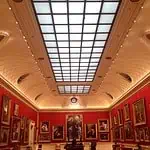
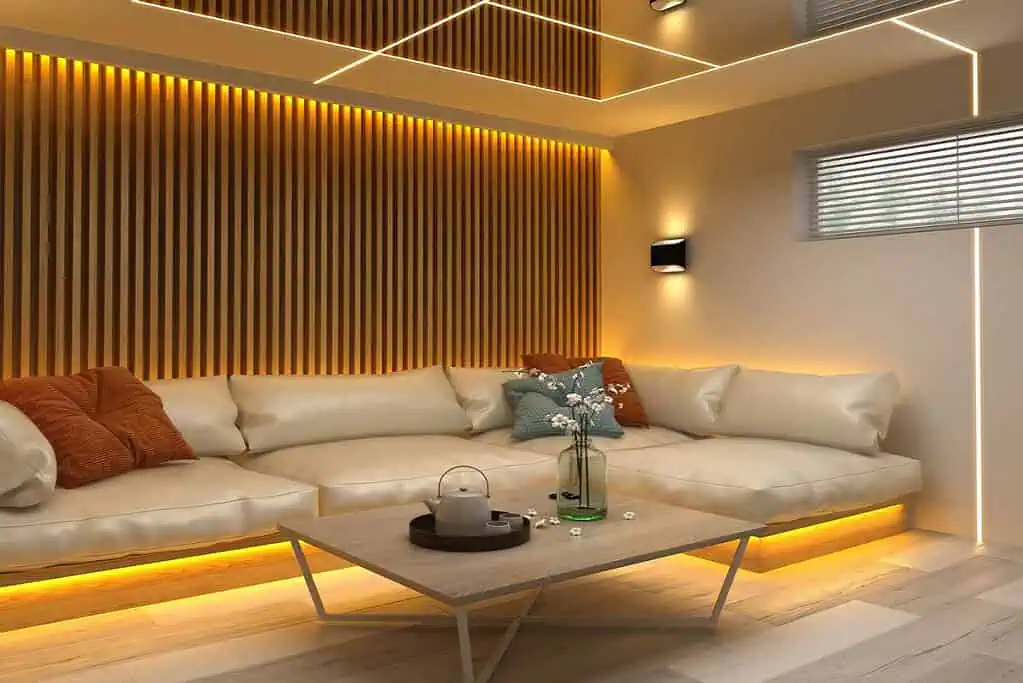
Ambient lighting, also known as general lighting, offers the main source of illumination in a room. Normally, it is set closer to the ceiling so that it can distribute light evenly across the entire room. As a matter of fact, ambient lighting is crucial for basic visibility and safe movement in a place.
Where To Use Ambient Lighting?
Ambient lighting is used in every room of a house. It can be set towards the center of the room. Usually, ambient lights are attached closer to the ceiling to diffuse light evenly throughout the room.
Things To Consider While Setting Ambient Lighting
- First, you need to select proper fixtures that will not create any glare.
- Use dimmable overhead lights so that you can adjust the brightness according to your needs.
- To set ambient lighting in corporate places, go for a neutral color temperature. For example, a temperature between 3000K and 4000K will help create a professional atmosphere.
Fixture Types For Ambient Lighting
- Indoor Ambient Lighting: Ceiling-mounted fixtures, track lights, wall-mounted fixtures, flush-mounted fixtures, floor lamps, flat panel LED lights, LED down lights, etc.
- Outdoor Ambient Lighting: Bollard and path light, lantern, canopy lighting, and recessed fixtures, sconce, etc.
2. Task Lighting
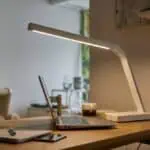
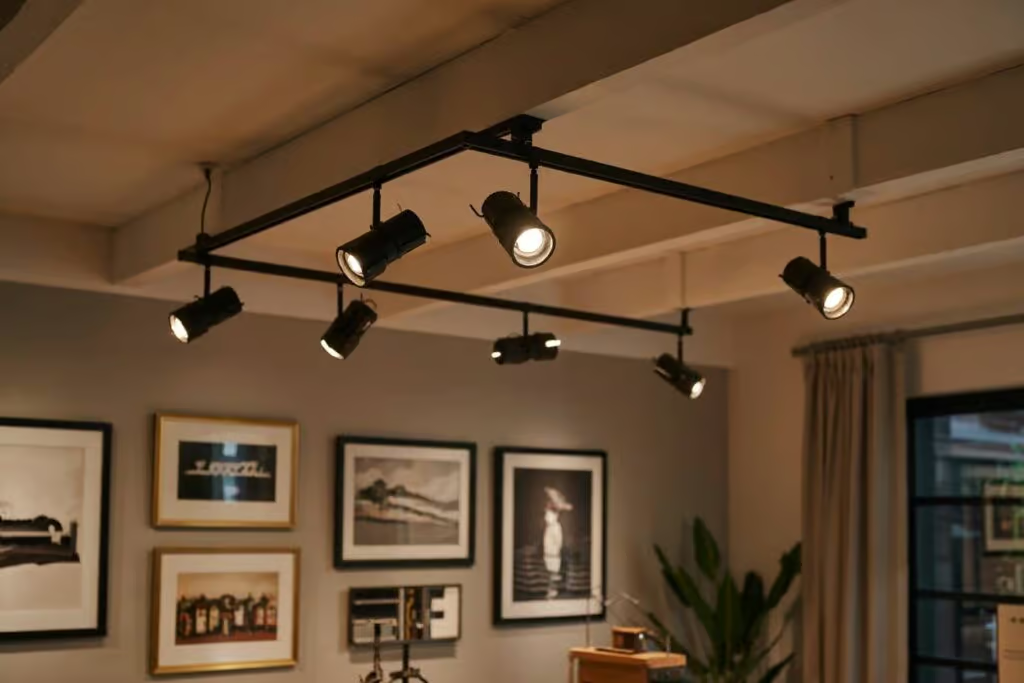
The main purpose of task lighting is to illuminate a particular area for a particular activity. For instance, make-up, reading, crafting, and cooking at home are done under task lighting. Apart from that, this lighting is used in detailed assembly jobs to help the workers focus and minimize errors.
Where To Use Task Lighting?
- Use it as a reading lamp in your bedroom
- As desk lamps for the study room and office
- Under the cabinets of your kitchen
- Vanity lighting and puck lighting in the bathroom
- Utilize it in front of the mirror for makeup purposes
- Above any working station for clear visibility
Things To Consider While Setting Task Lighting
- If you are using task lighting in retail fitting rooms, then go with a warm color temperature. It will make the clothes look more appealing.
- Make sure to use light fixtures with a narrow beam spread to get light exactly where it is required.
- Also, buy adjustable or flexible fixtures so that you can move the lighting source as you want.
- Your task lights should be slightly brighter than the ambient lighting of the room.
Fixture Types For Task Lighting
- Desk lamps
- Portable lamps
- Pendant lights
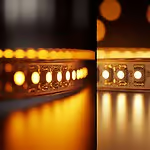
- Undercabinet, slimline bars, and extrusions
- Downlights
- Directional gimbal recessed fixtures
3. Accent Lighting
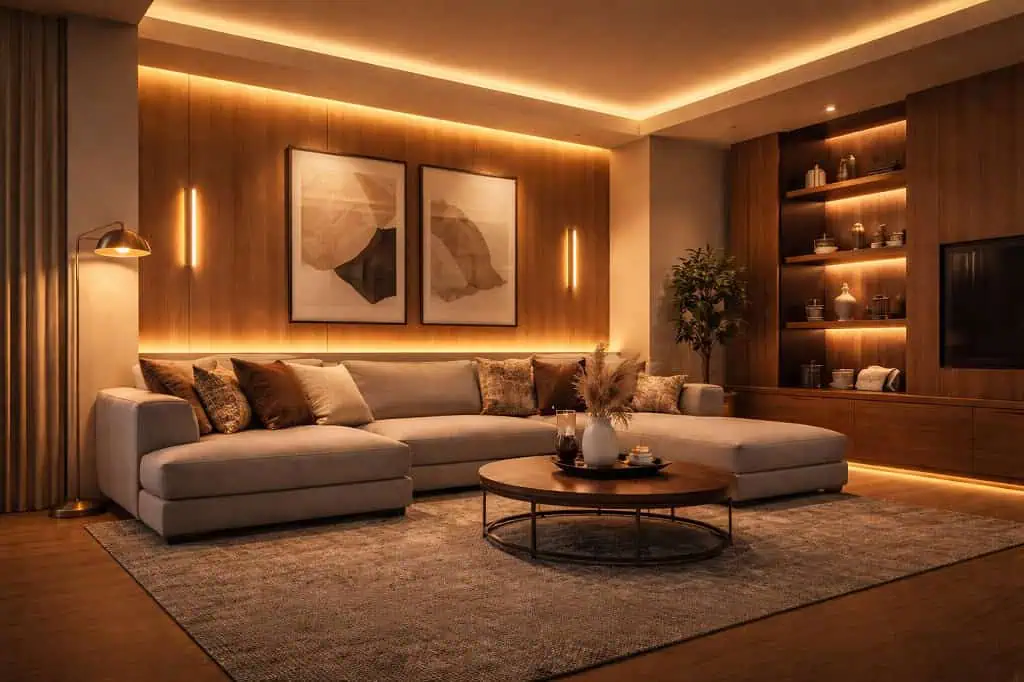
Accent lighting is mainly used to highlight specific features of a room by focusing light on that feature. For example, architectural design or artifacts can be brought to the spotlight of a space with this lighting. Moreover, it creates visual interest in a room.
Where To Use Accent Lighting?
- Utilize accent lighting to highlight the features of the artwork.
- Use it on plants or plant pots.
- Beautify architectural elements with this light.
- Also, you can outline the sides or railings of staircases with this.
- Set it as under-cabinet lighting in your kitchen.
- Use accent lighting in an archway, a fireplace, or crown molding.
Things to Consider While Setting Accent Lighting
- You have to create a clear contrast between the ambient and accent lighting in your room. It is essential to highlight key features of a place.
- Accent lighting should be at least twice as bright as the ambient lighting of a room.
- To spotlight decor with warm light, use wall-mounted sconces with a 3000K temperature when the ambient lighting is of 4500K temperature.
Fixture Types For Accent Lighting
- Wall-mounted fixtures
- Tape and extrusion
- Track lights
- Spotlights
- Cove lights
- Torchère lamps
4. Decorative Lighting
Decorative lighting bears the identity of your elegant taste. The main purpose of this lighting is to increase the aesthetic appeal of a place. You can style your home as you want with this lighting.

Where To Use Decorative Lighting?
- Decorative lighting can be used in the entrance of a house, hotel, or office.
- Restaurant waiting areas are designed with this lighting style.
- Pendants above a hotel concierge desk will create a cozy environment.
- It is also used over dining tables.
- Using this light, enhance the aesthetics of your living room.
- In addition, use it in wall sconces.
- You may attach it next to the fireplace.
Things To Consider While Setting Decorative Lighting
- Make sure that the placement of decorative lighting is perfect.
- Combine it with other functional lights to get work done.
Fixture Types For Decorative Lighting
- Wall sconce
- Light kits for ceiling fan
- Table lamp
- Floor lamp
- Pendant lights
- Patio string lights
- Fairy lights
How To Combine Lighting Types?- Light Layout
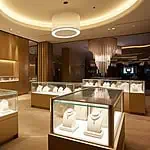
- In a Retail Store: First, set an ambient overhead flat-panel light to get basic illumination. After that, use accent lights to highlight the products on display. You will need task lighting for the employees at checkout counters. Finally, attach decorative lights to walls or different corners to create a unique design.
- In Office Space: Combine ambient lighting, like a flat panel, and task lights, like desk lamps, at workstations. Then add accent lighting on walls to highlight artifacts. It will create a professional environment. Lastly, use decorative lighting with the color of the company’s logo in the main entry point.
- In the Kitchen: Hang an overhead light first. Then utilize task lighting for under-cabinet lighting to do cleaning and cooking.
- In the Living Room: Using recessed downlights for ambient lighting is a popular option. Then add pendant lights for decoration. Also, lamps can be added as task lighting.
- In the Study Room: Add task lights to your reading table or desk. Also, you will need general ambient lighting across the room. Apart from that, accent lighting can be added within the bookshelf to highlight specific sections of books.
- In the Bedroom: Choose sconces or table lamps for a cozy atmosphere. Besides, you can opt for general visibility through a dimmable ceiling fixture.
Tips For Lighting Small Spaces
- Dispersion of Light: Only the main ceiling light is not enough to disperse light evenly across the room. So, use other options like panel lights, lamps to light up dark corners.
- Utilization of Wall or Ceiling Space: Lighting the wall space is a great lighting technique for small rooms. Installing lights around the mirror or bedframe makes a small room look wider. You may also use the ceiling space for lighting in a small area.
- Usage of Low-Hanging Pendants: The low-hanging pendants focus on the room’s height instead of surface area. So, attach a few pendants at different drop heights to make the room seem taller and bigger.
- Bouncing Light Technique: Make sure to paint the ceiling white in the small rooms. Then install floor lights. The ceiling will bounce light from fixtures and add depth to the dimension of the room.
- Selection of the Right Color Light Fittings: You need light coloured or clear glass light fixtures in a small room. To elaborate, the clear objects will create an illusion of more space. As a matter of fact, light can pass through glass light fittings, and natural light can flow evenly across the space.
- Application of String Lights: String lights can serve multiple functions in a small room. For example, it is dangled from the ceiling, hung over the bed, or wrapped around the headboard to save up space. In addition, it is available in multiple colors and shapes.
- Integration of Textured Lighting: Earthy textures and colors make a room seem larger. So, select textured lighting fixtures with neutral colors in your small space.
Using Smart Technology To Elevate Lighting
Smart technology has opened the door to automation and customization of various lighting solutions. Check out the options below to elevate lighting with smart technology:
- Remote Scheduling: You can schedule the lights to turn on and off with timers from outside of your home. It will help control overall energy usage.
- Dimming Options: Setting brightness and light intensity is easier with smart dimmers for your every mood. You can dim the light while relaxing and brighten it up while tasking in a click or press of buttons. Besides, the daylight sensor automatically dims the light, examining the environment.
- Occupancy Sensors: With modern sensors, lights turn on automatically when someone occupies the room. Also, it automatically turns off when the sensor can not detect anyone. This technology is useful for the basement, storage rooms, etc.
- Voice-controlled Lighting: Virtual assistants like Amazon Alexa, Google Assistant, or Apple HomeKit offer voice command options to control lighting. Basically, you will be able to change light colors and lighting scenes with your voice using this technology.
- Integration with Smart Home Devices: Smart lights can be connected with home theater, entertainment systems, security systems, smart thermostats, refrigerators, door locks, etc.
Mistakes To Avoid When Lighting A Room
Choosing the Wrong Color Temperature
The wrong color temperature can ruin the atmosphere of your home. To get a relaxing environment, choose a warmer color temperature and a cooler color temperature for focused tasks.
Also, do not forget to consider the paint color of the room before selecting the color temperature. A warmer color temperature of the lights will go with the warm paint color, and vice versa.
Ignoring Layered Lighting
Just one overhead light can not always offer maximum visibility with proper style. So, follow layered lighting with the basic four types of lighting, such as accent, ambient, task, and decorative lighting.
You are free to do horizontal, vertical, or depth layering. For example, in horizontal layering, lighting is evenly spread out across the ceiling and wall. In contrast, lights are installed at different heights in vertical layering. Furthermore, lights are set behind furniture or artwork in an in-depth layering.
Doing Incorrect Fixture Placement
Incorrect quantity or placement of fixtures may lead to glare or eye strain. So, calculate how many fixtures you need before buying them. For instance, you need six 40-watt bulbs in a room that needs a minimum of 240 watts. Then seek professional help to place those fixtures correctly.
Buying Off-theme Fixtures
Do not buy fixtures that do not match the interior design of the room. Fix the theme of your place beforehand. Then buy the fixtures accordingly. For example, choose a sleek and simple design for a minimalist look.
Not Using LED Lights
Not considering LED lighting options along with traditional lights is a huge mistake. LED lights are energy-efficient and long-lasting. In addition, it will give you more customization options for the desired look of your house.
Frequently Asked Questions
The Bottom Line
Lighting can be your creative tool to elevate the interior decor of your house. Combine both functionality and elegance while layering the lighting types at your place. Furthermore, the right fixture for the right purpose will make your lighting project successful and cost-effective.
Switch to modern LED lights to save your money and energy. LED strips can be your go-to choice for lighting needs. You can use it as general, ambient, task, and decorative lighting to get a professional light setup. So, choose the top-quality LED strips from LEDYi and take your interior lighting to the next level. Besides, we offer 3 to 5 years of warranty on our fixtures. So, contact us ASAP to place your order!