Inappropriate light distribution can hamper your total light setting. This is why knowing about IESNA and NEMA light distribution types and techniques is crucial for proper lighting. The Illuminating Engineering Society of North America (IESNA) and the National Electrical Manufacturers Association (NEMA) created some rules and categories for light distribution standards. These classifications help consumers make the right decision while choosing light fixtures.
So, dive in and find out the important information about the light distribution types.
Hide
What is Light Distribution?
Light is emitted from a source in different patterns, shapes, and intensities over an area. This phenomenon is called light distribution. As a matter of fact, proper distribution of light is critical. It is related to the right coverage, energy consumption rate, safety, functionality, and visual appeal. Light distribution pattern varies from narrow to broad depending on the space where it is used.
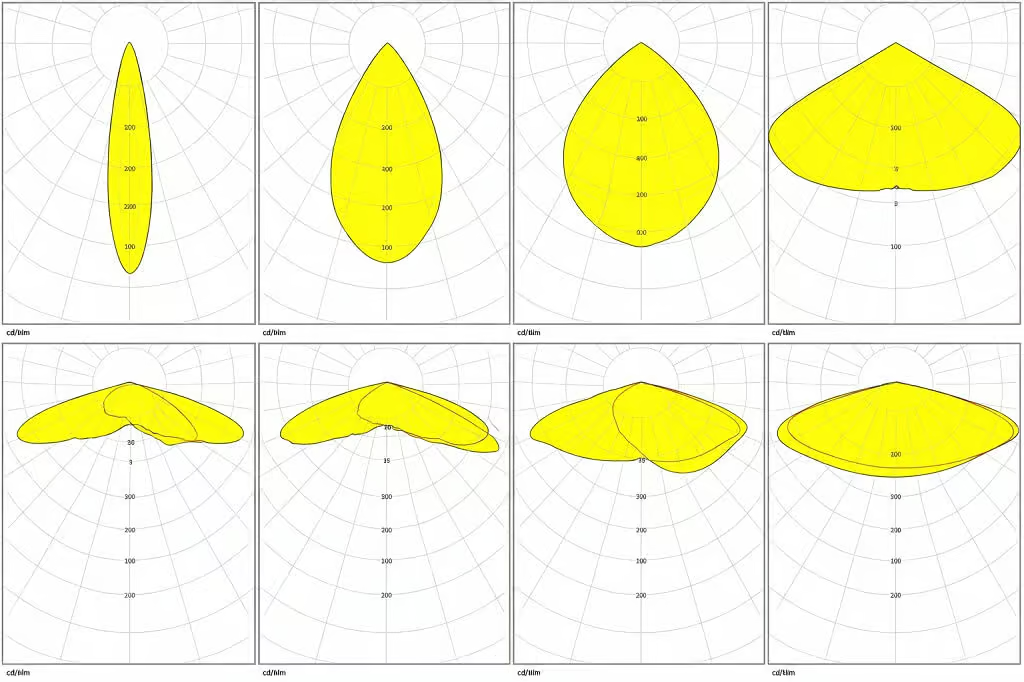
Light Distribution Diagrams
A light distribution diagram is made to show luminous intensity at different angles. The values are plotted in polar coordinates to show how light disperses from a light source.
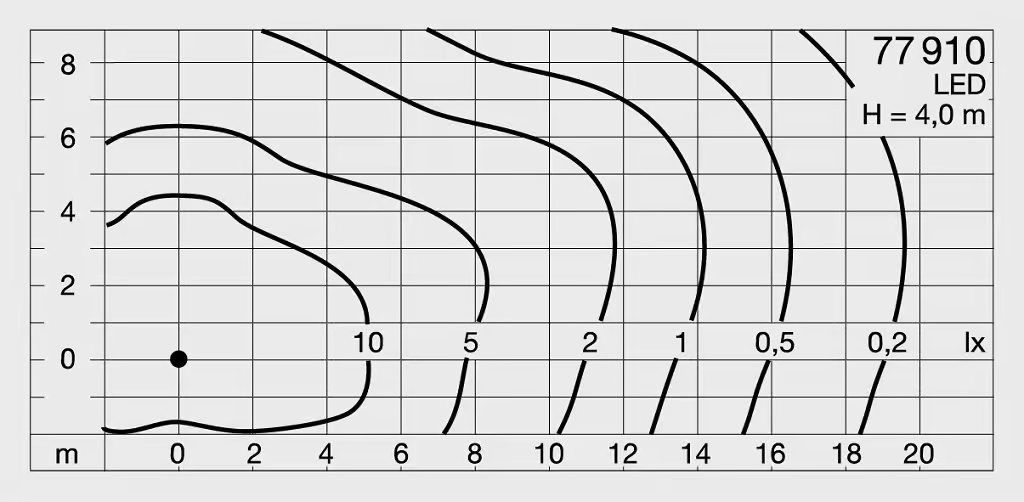
Isolux Diagram
This diagram measures the light intensity falling on a surface in a lux unit. It appears like a contour map or weather map. If you want to see dark spots, lighting uniformity, and layouts, use this diagram.
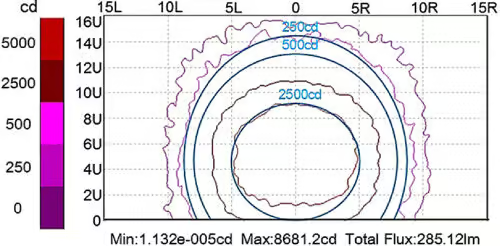
Isocandela Diagram
The isocandela diagram represents light intensity in candela units. It appears as a circular diagram with curves. These curves represent certain candela values.
What is IESNA Light Distribution?
IESNA stands for The Illuminating Engineering Society of North America, which classifies the light distribution patterns. The IESNA distribution type is used to find the best lighting option for outdoor lighting, such as street lighting and area lighting. The general shape of the light spread is used primarily to make IESNA light distribution categories.
IESNA Horizontal Light Distribution Patterns
IESNA horizontal light distribution describes how the light spreads laterally or horizontally from the source. The horizontal types based on the width of the light spread are discussed in this section.
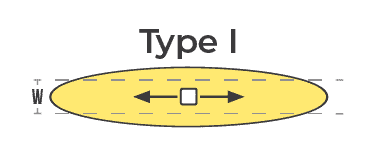
Type I
- Characteristics: The pattern of IESNA horizontal light distribution type I is narrow and symmetric. Moreover, the amount of light coverage is 1 MH on both sides of the source. It has a two-way lateral distribution pattern. Also, the light source is directed outward in opposite directions.
- Applications: It is best for pathways, walkways, and high-mast lighting. Also, the mounting height for this light should be almost equal to the width of the area.
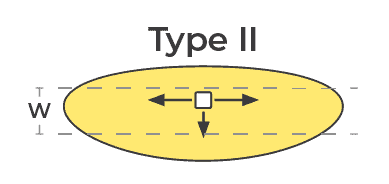
Type II
- Characteristics: The light distribution pattern is narrow and asymmetric. Moreover, it spreads from 1 MH to 1.75 MH on the street side. Light is directed outwards to the sides like Type I, along with additional forward light distribution.
- Applications: It is applicable for roadways, bike paths, and walkways that need a bit wider coverage. The area width for this light should not be over 1.75 times the mounting height.
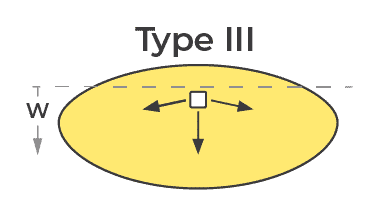
Type III
- Characteristics: Type III light distribution has a wide and asymmetric pattern. It distributes light farther forward than Type II. Also, it extends from 1.75 MH to 2.75 MH on the street side.
- Applications: Parking lots, area lighting requiring a broader coverage, use this type of light distribution. The area width should be less than 2.75 times the mounting height when you install the light.
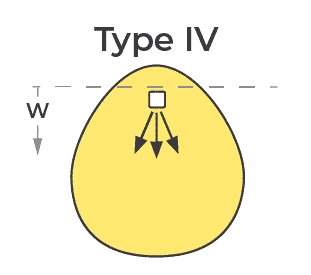
Type IV
- Characteristics: Type IV light distribution has an asymmetric forward throw pattern. As a matter of fact, it does not spread light sideways. Furthermore, this light extends beyond 2.75 MH but less than 3.7 MH on the street side.
- Applications: The Type IV pattern offers high illumination over wider areas. It is used for perimeter lighting on poles or walls, airport runways, highways, etc. Finally, the area width for this light must be within 3.75 times the mounting height.
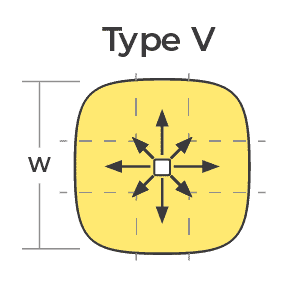
Type V
- Characteristics: Type V has a symmetrical and circular pattern. So, you will find an even distribution of light in all directions with this type.
- Applications: It is used in bigger spaces such as parking lots, fields, and junctions.
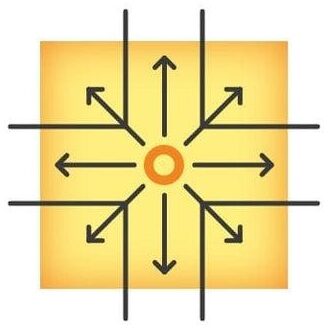
Type VS
- Characteristics: This light distribution has a symmetrical and square pattern with consistent intensity.
- Applications: Type VS is applied in parking lots and large areas requiring even light coverage.
IESNA Vertical Light Distribution Patterns
The IESNA vertical light distributions represent how far the light reaches from its mounting height. Now, look at the vertical classifications below.
| Features | Very Short | Short | Medium | Long | Very Long |
| Maximum Intensity | 0 – 1.0 MH | 1.0 – 2.25 MH | 2.25 – 3.75 MH | 3.75 – 6.0 MH | More than 6.0 MH |
| Suggested Pole Distance | 1 MH | 1.0 to 2.25 MH | 2.25 MH to 3.75 MH | 3.75 MH to 6 MH | More than 6 MH |
What Is NEMA Light Distribution?
NEMA, or the National Electrical Manufacturers Association, is a trade association of the United States. It has categorized seven light distribution patterns for different lighting needs. NEMA types show the beam angles that measure 10% of the maximum horizontal and vertical beam intensity area. Here, a wider beam spread means a shorter projection distance when the wattage is the same. Generally, it is used in flood lighting and spot lighting.
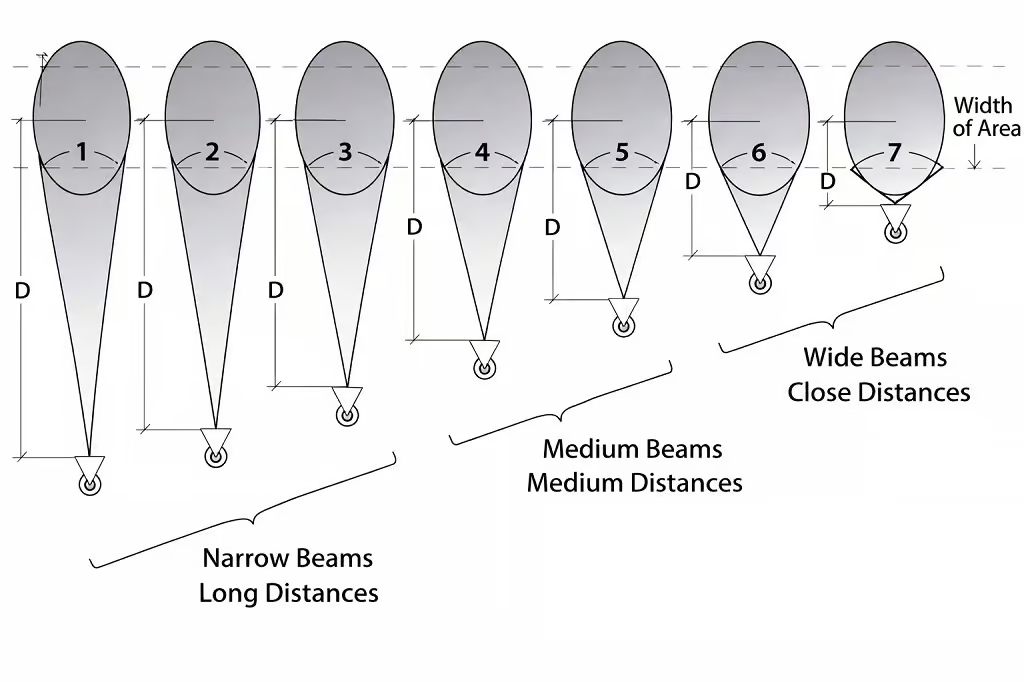
NEMA Light Beam Types
Type 1
- Feature: Very narrow.
- Beam Angle: 10-18 degrees.
- Beam Projection Distance: More than 240 feet.
- Applications: It is appropriate for spotlighting, highlighting tall structures and long distances like high towers or architectural features.
Type 2
- Feature: Narrow.
- Beam Angle: 18-29 degrees.
- Beam Projection Distance: 200-240 feet.
- Applications: This type of light distribution is appropriate for precision lighting. For example, small sports courts, focused floodlighting in designated areas, etc.
Type 3
- Feature: Medium narrow.
- Beam Angle: 29- 46 degrees.
- Beam Projection Distance: 175-200 feet.
- Applications: In smaller sports fields and localized floodlighting setups, this type of light is used.
Type 4
- Feature: Medium.
- Beam Angle: 46-70 degrees.
- Beam Projection Distance: 145-175 feet.
- Applications: It is utilized in mid-sized sports fields, parking lots, general floodlighting, etc.
Type 5
- Feature: Medium wide.
- Beam Angle: 70-100 degrees.
- Beam Projection Distance: 105-145 feet.
- Applications: These are used in larger areas for broader illumination, like recreational sports fields, parking lots, landscaping, sign lighting, etc. The wider beam angle offers a balance between setback distance and beam spread.
Type 6
- Feature: Wide.
- Beam Angle: 100- 130 degrees.
- Beam Projection Distance: 80- 105 feet.
- Applications: It is best-suited for large sports fields, stadiums, and open areas that require even light distribution.
Type 7
- Feature: Very wide.
- Beam Angle: More than 130 degrees.
- Beam Projection Distance: Less than 80 feet.
- Applications: It is used in public parks and industrial zones needing uniform brightness over a large space.
NEMA Beam Angle Measurement Guide
Two numbers normally denote NEMA types. The first number represents the horizontal type and the second number represents the vertical type. In addition, the equation for finding the NEMA type for an asymmetrical beam spread is as follows:
| Asymmetrical Beam Spread = Xº H (Horizontal Spread) by Xº V (Vertical Spread). |
For instance, NEMA 7 X 6 means the light has a Type 7 horizontal width and a Type 6 vertical height. In other words, its horizontal beam spread will be more than 130°, and its vertical beam spread will be 100-130°. Again, these classifications are sometimes written in short forms such as 7H6V.
Factors To Consider For Setting Beam Angles
- Desired Lighting Effect: Use narrow beam angles for accent lighting and wide angles for general illumination.
- Size of the Area: If you are dealing with larger areas, a wider angle is appropriate for it. In the same way, narrower beam angles are better for focused and tiny areas.
- Ceiling Height: For high ceilings, you need to use narrower beam angles to get maximum visibility.
- Energy Efficiency: Consider the energy consumption rate and how you can minimize waste while selecting beam angles.
Some Common Beam Spreads
Ultra Spotlight 1H1V
It is also known as NEMA I. This is commonly used for very long-range applications. Modern LEDs can create a 12, 15 or 20 degree pattern with a high rate of accuracy.
Spotlight 3H3V
This beam is popular because it works best at 40-60 ft height. It is also known as NEMA III. The 1500-watt HID sports lights and the 500-watt stadium lights are classified under this category. It is easily created with a large metal reflector around an HID bulb.
4H4V
4H4V or NEMA IV is a common beam angle found in different fixtures. Generally, high bay lights and some sports lights use this 60-degree beam.
H5V3 Wide Short Pattern
Here, the horizontal pattern is increased while holding the vertical pattern. It is commonly seen in street lighting.
H3V5 Narrow Tall
H3V5 narrow tall beam is an uncommon beam. It is flipped with a tall pattern to highlight buildings and signs.
H5V5 Wide Flood Pattern
This is commonly used as a 90-degree pattern for heights around 30-40 feet. It drives more light to the ground.
H6V6 Ultra Wide Flood
H6V6 Ultra Wide flood is known for its wide coverage. It is usually used in residential wall lights and smaller flood lights.
What Are the Main Differences Between IESNA and NEMA Lighting Distribution Types?
| Features | IESNA Light Distribution | NEMA Light Distribution |
| Criteria for classification | Distribution of light in a horizontal plane. | Beam spread of light on both vertical and horizontal angles. |
| Pattern of light spreading | Light spreads out across a plane. | Here, light spreads out at certain angles. |
| Beam angle | IESNA types measure the beam angle where the light is at 50% of the maximum candela. | NEMA measures certain beam angles where the light is at 50% and 10%. |
| Applications | Outdoor lighting systems like roadways, parking lots, and footpaths, etc. | Floodlights and spotlights. |
| Range | Type I, II, III, IV, V, VS. | Type 1 to Type 7. |
How To Choose The Best Light Distribution Type Based On Project Needs?
- Analyse Your Lighting Needs: First, determine the project goals and place of lighting. For example, the light distribution type will vary depending on places like parking lots, supermarkets, stadiums, narrow roads, etc. If you need general illumination, then choose types with wide distribution. In addition, for task lighting, you will need distribution types with focused beams.
- Area Size: Bigger areas require wider distributions, such as type III, V. Again, types I, II with focused beams are suitable for smaller areas.
- Mounting Height: Consider the mounting heights before selecting light distribution types. It significantly affects the desired light coverage.
- Environmental Factors: Think about the typical weather conditions of the place where you are fixing the lighting system. Strong winds and frequent rain can affect light distribution.
- Nature of the Surface: The outcome of light is changed due to different surfaces. For instance, a highly reflective surface amplifies light, but a darker surface absorbs light.
Effects of Mounting Height on Illumination
Mounting height affects the illumination of a source for its intended target. It is the vertical distance between the lowest point of the light fixture and the ground directly below it.
- Higher Mounting Heights: In terms of higher mounting heights, light covers a larger area by spreading out more. It is used in street lighting. Additionally, it reduces shadows and provides even illumination. However, light intensity decreases here, and it requires a higher wattage.
- Lower Mounting Heights: Mounting is done at lower heights for task lighting because light remains concentrated in a smaller area. It also needs a lower wattage fixture as light intensity increases here. Unfortunately, it creates harsh shadows or glare.
Lighting Distribution Applied in Outdoor Luminaires
Street and Roadway Lighting
Street lighting requires uniform illumination along roads and pedestrian paths. So, recommended light distribution types for this purpose are types II, III, and IV. These are used in city streets, highways, and residential roads.
First, type II provides a narrow, asymmetric distribution, and it is suitable for minor roads and walkways. After that, type III offers a wide and asymmetric distribution for larger streets. Finally, type IV ensures forward-throw for intersections and wide roadways.
Post Top Lighting
Post top lighting is seen in parks, plazas, and sidewalks for decoration purposes. The preferred light distribution types for post top lighting are type V and type VS.
Type V light distribution is symmetrical, circular, and provides even illumination in all directions. Again, type VS is symmetrical and square, suitable for uniform lighting in plazas and gardens.
Parking Lot Lighting
Parking lot lighting in airports, commercial space uses type III, IV, and V light distribution patterns. Type II offers a wide coverage for large parking spaces. After that, type IV with forward-throw is better for perimeter lighting. Finally, type V with a circular pattern is used in central zones.
Sports Lighting
Football fields, tennis courts, and stadiums need specific sports lighting. NEMA types 1–3 with narrow beams are used in tall poles for focused illumination. In addition, NEMA types 4–6 with medium to wide beams are used in bigger fields.
Flood Lighting
Flood lighting is necessary in large outdoor areas and architectural highlights. The NEMA types 2–6 are recommended for these areas. Also, type IV with asymmetric forward-throw is better for controlled area lighting.
Future Development In Light Distribution
- LED Technology: LEDs have the potential to develop flexibility, directional accuracy, and controllability of light distribution.
- Smart Lighting: Intelligent systems in smart lighting will optimize light distribution, brightness, and color based on specific needs. For example, Internet of Things (IoT), sensors, Zigbee, Bluetooth, etc, will improve the outcome of light distribution.
- Human-centric Lighting: It means creating dynamic lighting that will mimic natural daylight patterns. Integration of this technology with light distribution systems will help in improving the mood, productivity, and sleep patterns of the users.
- Sustainable Lighting: Through sustainable lighting, the environmental impact can be reduced with minimal waste. It will distribute light effectively to get maximum visibility with minimum light pollution.
FAQs
The Bottom Line
Understanding light distribution types is critical to setting the lighting system of a place. IESNA light distribution types are used for outdoor lighting, while NEMA types are used for focused lighting. Choose the types based on how narrow or wide the coverage you need.
LED technology uses the light distribution patterns to optimize lighting control. So, you can get LED products with specific distribution types from imltled.
Besides, you will get the desired products according to your needs, along with various customization options. Moreover, we offer you 3 to 5 years of warranty on our fixtures. So, contact us ASAP to place your order!